
On this page
- What is the side-by-side comparison?
- Why does humidity matter so much?
- What about falling limbs and storms?
- Which houses suit each material?
- What about vinyl?
- What are the hidden costs?
- How do you choose?
- How does each material handle the heat?
- What about galvalume and coated steel?
- Which choice is best for resale?
- Can the material be changed when replacing?
- Which material handles pine debris best?
- Which material is easiest to repair?
- Next steps
What is the side-by-side comparison?
| Aluminum | Steel | Copper | |
|---|---|---|---|
| Rust in humid air | Does not rust | Rusts if the coating is breached | Does not rust; develops patina |
| Dent resistance | Fair to good by gauge | Good | Soft; dents rarely leak |
| Weight | Light | Heavy | Moderate |
| Seamless on site | Yes, common | Yes, less common | Yes, some installers |
| Colors | Dozens | Several | Natural metal only |
| National price | About $9 to $13 a foot for 5-inch | Similar to or above aluminum | About $25 to $40 a foot |
| Lifespan | Often 20+ years | Similar while coated | Many decades |
Why does humidity matter so much?
Bush Intercontinental averages close to 75 percent relative humidity, with rain on about 104 days a year. Gutters here are wet or damp much of the time, and wet debris holds moisture against the metal for days. That makes corrosion the main question.
- Aluminum forms a thin oxide layer that protects it. It does not rust, and factory paint adds another layer.
- Steel depends on its zinc or paint coating. Scratches from ladders, limbs or cleaning tools expose bare steel, and in damp air rust starts there.
- Copper does not rust. It darkens and eventually turns green, and humid air tends to speed the change.
What about falling limbs and storms?
Limbs are a real risk under the tall pines and oaks common around Spring. Loblolly pine is the most common native tree in the region, and oaks are next. Storms bring branches down: Hurricane Beryl's gusts reached 58 mph in Spring, and the May 2024 derecho brought winds estimated up to 100 mph to parts of the region.
- Steel resists dents best.
- Heavier .032-inch aluminum is a good middle ground and much stiffer than thin coil.
- Copper dents, though the dents rarely leak.
No gutter survives a large limb landing on it. What keeps gutters on the house in high wind is how they are hung: hidden hangers about every two feet into sound fascia.
Which houses suit each material?
| Material | Best fit around Spring |
|---|---|
| Aluminum | Most subdivision and brick homes; any color scheme |
| Heavy-gauge aluminum | Wooded lots where limbs fall; two-storey homes |
| Steel | Homes where dent resistance matters most and coatings will be maintained |
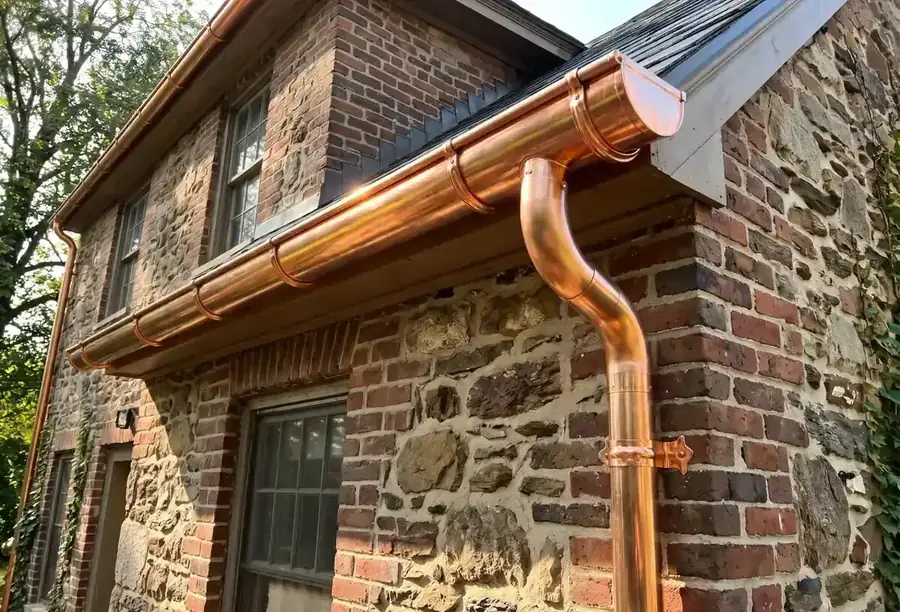
| Copper | Custom, stone and traditional homes; historic buildings in Old Town Spring |
What about vinyl?
Vinyl gutters are cheap and sold at home stores in sections. Heat makes them sag and sunlight makes them brittle, so they rarely suit a professional install here.
What are the hidden costs?
- Steel needs touch-up paint where scratched.
- Copper needs copper fasteners and hangers, and its runoff can stain light concrete or stone.
- Any material needs sound fascia; in humid air, soft wood is common behind old gutters. See fascia and soffit repair.
How do you choose?
For most owners, heavy-gauge seamless aluminum in a color that suits the trim is the practical choice. Choose copper if the house calls for it and you plan to stay. Choose steel only if dent resistance outweighs the rust risk and you will keep the coating up.
How does each material handle the heat?
Summer heat makes metal expand and contract every day. Aluminum moves the most, which is why very long aluminum runs sometimes get an expansion joint. Steel moves less. Copper sits in between and handles movement well when soldered. In all three, the joints and sealant take the strain, which is why fewer joints, as in seamless gutters, last longer.
What about galvalume and coated steel?
Coated steel gutters, including galvalume, have a metallic coating that resists rust better than plain galvanized steel. They are strong and dent-resistant, which can help under falling limbs. The weak points are cut edges, scratches and the places where fasteners pierce the coating. In air this humid, those spots are where rust starts. If you choose steel, ask which coating it has and how cut ends are treated.
Which choice is best for resale?
Buyers rarely ask what gutters are made of, but they notice gutters that sag, stain or overflow. Seamless aluminum in a color that suits the house is what most buyers expect. On a custom or traditional home, copper can be a selling point. Steel showing rust is a negative. Whatever the material, clean, well-hung gutters with downspouts carried away from the slab are what an inspector will look for.
Can the material be changed when replacing?
Yes. Many owners replace old steel or sectional gutters with seamless aluminum, and some move up to copper on part or all of the house. The main limits are the fascia, which must be sound for any material, and metal contact: copper must not touch remaining aluminum or galvanized parts.
Which material handles pine debris best?
The material makes little difference to clogging; size, outlets and guards matter far more. Wet needles do hold moisture against the metal, which can stain aluminum finishes, speed rust on scratched steel and blotch copper's patina. Keeping gutters clean protects all three.
Which material is easiest to repair?
Aluminum. Sections, corners and downspouts are easy to replace and color-match. Steel needs care with cut edges, and copper needs soldering.