
On this page
- When do screens and reverse-curve covers make sense?
- How do the guard types compare?
- How does heavy rain affect each type?
- Screen or micro-mesh?
- What should installation include?
- How much do these guards cost?
- How do you clean a gutter that has a screen?
- What about solid covers with a nose?
- Are DIY guards worth it?
- Related pages
When do screens and reverse-curve covers make sense?
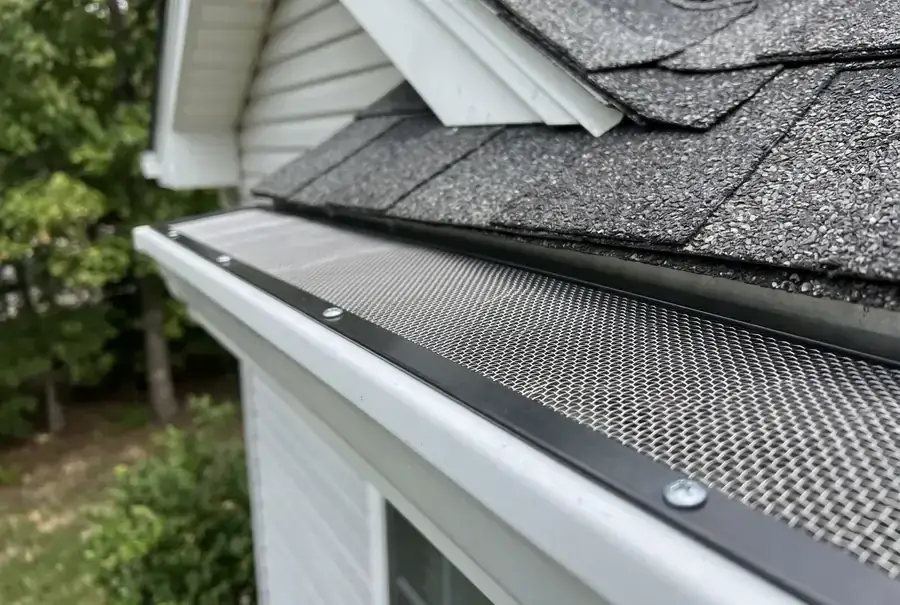
When the main debris is large leaves and there are few or no pines nearby. A newer house with young trees, or a lot with oaks and magnolias but no loblollies, can do well with a simple screen. The trouble starts when needles arrive: loblolly pine is the most common native tree in the region, and its 6- to 9-inch needles slide through perforations end-first.
How do the guard types compare?
| Perforated screen | Reverse-curve cover | Foam or brush insert | Micro-mesh | |
|---|---|---|---|---|
| How it works | Holes let water in; leaves stay on top | Water follows a curve into a slot | Fills the gutter; water seeps through | Fine stainless mesh on a frame |
| Big leaves | Good | Good | Fair | Good |
| Pine needles | Slip through | Can slip under the lip | Stick in it | Stay out |
| Heavy rain | Good | Can overshoot | Falls as it clogs | Good |
| Humidity | Fine | Fine | Holds moisture, can grow mildew | Fine |
| Cost | Low to moderate | Moderate to high | Low | Higher |
How does heavy rain affect each type?
Bush Intercontinental records about 52 inches of rain a year and measurable rain on about 104 days, and summer storms can dump an inch or more in under an hour. Screens pass water well. Reverse-curve covers rely on water clinging to the curve; in a cloudburst on a steep roof, some shoots past and lands beside the house. Foam inserts slow water down more and more as they fill with debris.
Screen or micro-mesh?
| Your situation | Likely best fit |
|---|---|
| No trees near the roof | Screens, or no guards at all |
| Oaks and magnolias, no pines | Screens or reverse-curve |
| Loblolly pines overhead | Micro-mesh |
| Steep or two-storey roof under trees | Micro-mesh, fitted by a contractor |
| Mixed pines and oaks | Micro-mesh |
What should installation include?
- Clean and inspect the gutters, and fix sagging, leaks and pitch first.
- Pick a guard sized for the gutter.
- Fasten it securely so wind cannot lift it; Hurricane Beryl brought gusts near 58 mph to Spring.
- Avoid lifting or nailing through shingles in ways that can void a roof warranty; follow the maker's method.
- Test with a hose.
How much do these guards cost?
National guides put installed gutter guards across a wide range per foot, with screens near the low end and reverse-curve covers and micro-mesh higher. HomeAdvisor's figures show the same spread. A cheap guard that lets needles through can cost more in the long run, because cleaning a gutter under a guard is harder than cleaning an open one.
How do you clean a gutter that has a screen?
Screens keep big leaves out, but needles and grit build up underneath. To clean, the screen is unclipped or lifted section by section, the gutter cleared, and the screen refitted. That takes longer than cleaning an open gutter, so under pines a cheap screen can make each cleaning more expensive. Snap-in screens are easiest to lift; screws and clips take longer.
What about solid covers with a nose?
Reverse-curve covers rely on water following the curve into a narrow slot. That works well in moderate rain. In the heaviest Gulf Coast cloudbursts, fast water on a steep roof can jump the curve and land beside the house. The slot can also collect pollen and fine debris. On low-pitch, single-storey roofs with oaks rather than pines, they can do well.
Are DIY guards worth it?
Store-bought screens and foam inserts cost little and can be fitted from a ladder on a single-storey house. They suit houses with few trees. Under pines, they tend to make the problem worse, because needles end up trapped under or inside them. If you try them, check after the first few weeks of needle drop.