
On this page
- Why do pine needles defeat most guards?
- What do Spring-area trees drop?
- How does micro-mesh compare with other guards?
- Will micro-mesh handle the rain here?
- What does a good micro-mesh installation include?
- What upkeep does micro-mesh need?
- How much does micro-mesh cost?
- What should the warranty and product details say?
- Related pages
Why do pine needles defeat most guards?
Loblolly pine is the most common native tree in the Houston region, about 19 percent of all trees. Its needles are 6 to 9 inches long and come in bundles of three. A long, thin needle slides end-first through the holes in a perforated screen, threads into foam inserts, and slips under the lip of many solid covers. Once inside, needles lie across the outlet and catch everything that comes after them.
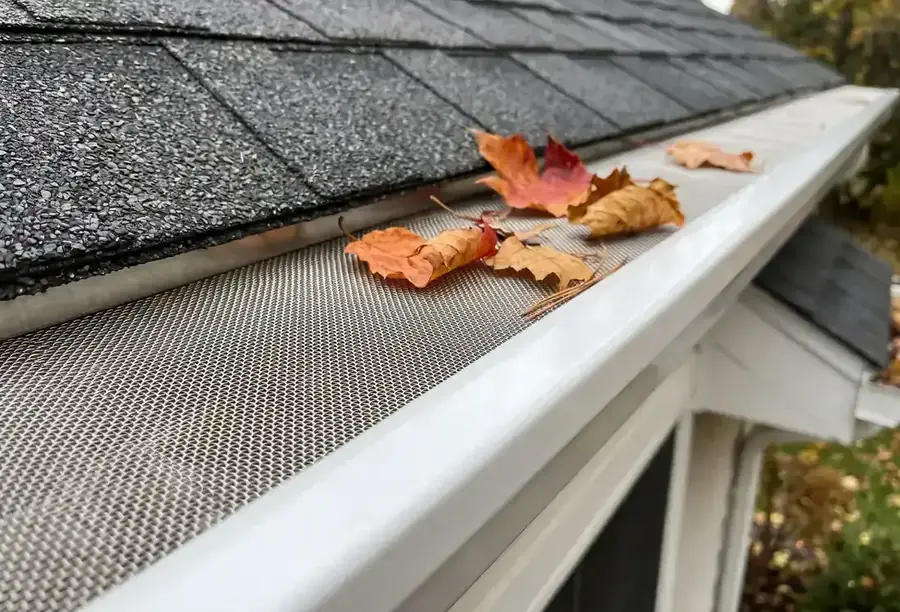
Micro-mesh works because the openings are far smaller than a needle's width. The needle lies on top and either blows off or is brushed away.
What do Spring-area trees drop?
| Tree | Debris | Micro-mesh result |
|---|---|---|
| Loblolly pine | Long needles, cones, pollen | Needles stay on top; pollen may film the mesh |
| Live oak | Leaves and catkins, mostly in late winter | Stay on top and blow off when dry |
| Water and willow oak | Leaves and acorns | Stay on top |
| Sweetgum | Spiky seed balls | Roll off or sit on top |
| Magnolia | Large, leathery leaves | Stay on top |
How does micro-mesh compare with other guards?
| Guard | Pine needles | Oak catkins and pollen | Heavy rain | Typical cost |
|---|---|---|---|---|
| Stainless micro-mesh | Keeps them out | Mostly keeps them out | Good when installed right | Higher |
| Perforated screen | Needles slip through | Pass through | Good | Low to moderate |
| Reverse-curve cover | Needles can slip under the lip | Can collect at the slot | Can overshoot in cloudbursts | Moderate to high |
| Foam or brush insert | Needles stick in | Clog the foam | Fair, falls as it clogs | Low |
See screens and reverse-curve guards and are gutter guards worth it.
Will micro-mesh handle the rain here?
Rain is heavy and frequent. Bush Intercontinental averages about 52 inches a year, with June near 6 inches. Good micro-mesh passes a lot of water, but the guard is only one part. The gutter has to be large enough, pitched correctly, and have outlets the water can reach. On big two-storey roofs a contractor may suggest 6-inch gutters with mesh, or an extra downspout below a valley.
What does a good micro-mesh installation include?
- Clean and inspect the gutters, and repair loose hangers, leaks or bad pitch.
- Choose a guard sized to the gutter, 5-inch or 6-inch.
- Fit the frame under the shingle edge or onto the drip edge as the maker specifies, without lifting shingles.
- Fasten it so wind cannot lift it, which matters in hurricane season.
- Seal the corners where guards meet.
- Test with a hose to watch water go through the mesh.
What upkeep does micro-mesh need?
Much less than open gutters, but not none. Check after big leaf drops and after storms. In spring, pine and oak pollen can film the mesh; a soft brush or a gentle rinse clears it. Once or twice a year, look into the downspouts. Micro-mesh is a good fit for anyone who no longer wants to go up a ladder several times a year. See how often to clean gutters.
How much does micro-mesh cost?
National guides show installed gutter guards across a wide range per foot, with stainless micro-mesh near the top. HomeAdvisor's figures show the same spread. Compare that with the cost of cleaning several times a year under heavy pine cover. Get a written quote that names the product, the mesh material and the fastening method.
What should the warranty and product details say?
Ask the contractor to name the guard brand and model, the mesh material (stainless steel is the one that lasts), the frame material, and how it fastens. Ask what upkeep the maker expects and whether cleaning the top is included in any service plan.