
On this page
Why does gutter size matter so much here?
Because gutters are sized for the hardest rain, and the Houston area gets some of the hardest rain in the country. Bush Intercontinental averages about 52 inches a year, with June at about 6 inches, and extreme events are part of the record: during Tropical Storm Allison in 2001, up to 37 inches fell on parts of the city in five days. On July 8, 2024, Hurricane Beryl dropped 7.2 inches on the Spring area.
Each square foot of roof sheds about 0.62 gallons for every inch of rain. A 2,500-square-foot roof in a one-inch storm sends more than 1,500 gallons to its gutters. If half drains to one long back run, that run has to carry it, and in a cloudburst it has to do so in minutes.
How do 5-inch and 6-inch compare?
| 5-inch K-style | 6-inch K-style | |
|---|---|---|
| Capacity | Standard | About 40% more |
| Usual downspout | 2x3 | 3x4 |
| Best for | Single-storey, modest roofs | Large, steep or two-storey roofs, valleys |
| Pine needles | Smaller outlet plugs sooner | Larger outlet passes needles and leaves |
| Cost | Lower | Somewhat higher per foot |
For a longer comparison, see 5-inch vs 6-inch gutters.
Which Spring houses benefit most?
- Two-storey houses in master-planned communities like Gleannloch Farms, where large upper roofs drain onto lower ones.
- Big hip roofs on brick homes, with valleys that pour onto one corner.
- Houses under loblolly pines, where larger outlets clog far less.
- Steep roofs on custom homes in Champion Forest, where water moves fast.
- Metal roofs, which shed water quickly with nothing to slow it.
How do the downspouts change?
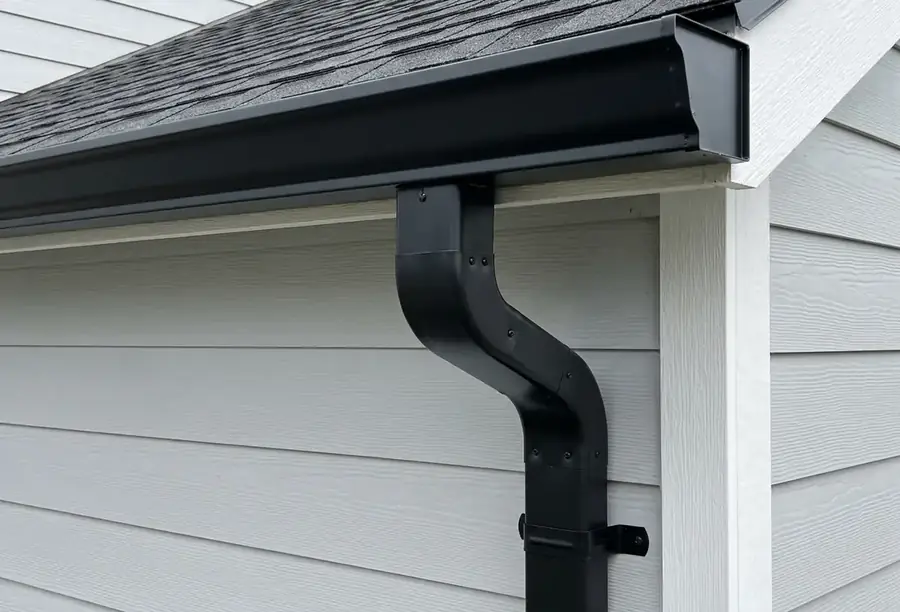
A 6-inch gutter is usually paired with 3x4-inch downspouts instead of 2x3. The larger downspout drains much faster and is far less likely to plug at the elbow with needles or sweetgum balls. On long runs, two outlets help too. Wherever the water comes down, it still has to be carried well away from the slab; see downspouts.
How can you tell if your gutters are too small?
| Sign | What it suggests |
|---|---|
| Water sheeting over the whole run in a storm | Gutter too small or too few downspouts |
| Overflow only at an inside corner | Valley water overwhelming that spot |
| Overflow right above a downspout | Downspout too small or clogged |
| A trench or splash marks in the soil below the eave | Repeated overflow |
| Mildew or stains on fascia and brick below the gutter | Overflow over many storms |
If the gutters were clean when they overflowed, size is the likely problem.
How much do 6-inch gutters cost?
National price guides put seamless aluminum at about $9 to $13 a foot installed for 5-inch, and 6-inch costs more per foot, plus the larger downspouts. The added cost on a typical house is usually modest compared with fascia rot or foundation trouble from overflow. These are national figures; get a written quote that states the size and gauge.
When is 5-inch still enough?
On a single-storey house with a modest roof, no valleys and no trees overhead, 5-inch gutters with well-placed downspouts usually cope. If they only overflow at one corner, an extra downspout may fix it. The contractor should explain which size they recommend and why.
Do 6-inch gutters need different guards?
Yes. Guards are made to fit a gutter width, so a 6-inch gutter needs a 6-inch guard. Micro-mesh is made in both sizes. If you are upgrading and plan to add guards, price them together so the contractor fits the right size.
Related pages
- Seamless gutters.
- Downspouts.
- Gutter replacement if you are upsizing old gutters.