
On this page
- How are seamless gutters made?
- Why do fewer joints matter around Spring?
- How do seamless and sectional compare?
- Which sizes and materials are available?
- How much do seamless gutters cost?
- What makes a seamless installation good?
- How should long runs be planned?
- What questions should you ask on the day?
- Related pages
How are seamless gutters made?
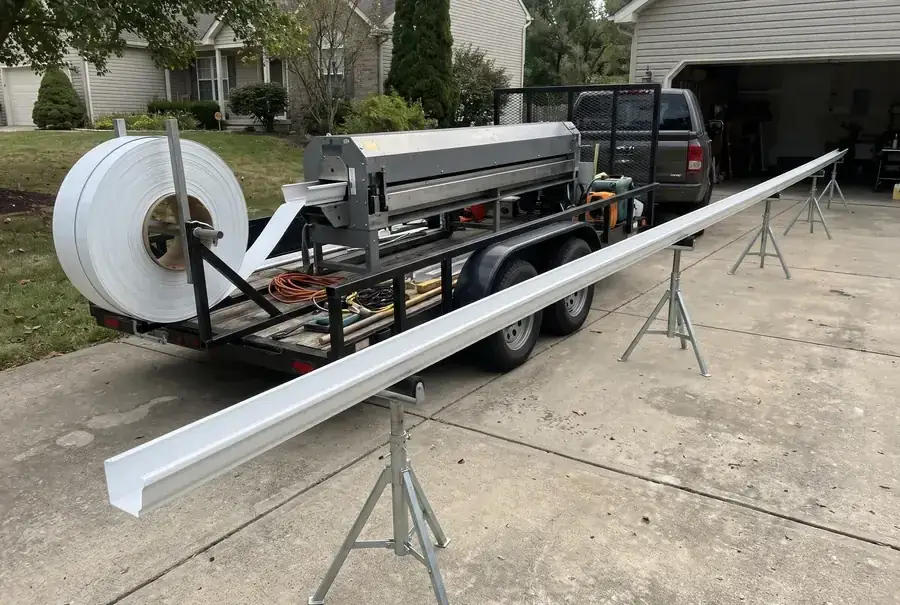
The installer arrives with a forming machine on a trailer and a coil of pre-painted metal. The coil runs through a set of rollers that bend it into a gutter profile, usually K-style, and the machine cuts each length to match a measured eave. A 45-foot back wall gets a single 45-foot gutter. The installer then cuts and joins the corners, fits end caps, punches outlets for the downspouts and hangs each run.
Why do fewer joints matter around Spring?
Each joint in a gutter is a seam held together with sealant, and sealant is what wears out first. Around Spring it is attacked from two sides. Summer heat makes the metal expand and contract every day, working the joint loose, and constant moisture keeps the seam wet. Bush Intercontinental Airport records measurable rain on about 104 days a year and humidity near 75 percent. A sectional system with a joint every ten feet has many more places to fail than a seamless one.
When a joint opens, it drips onto the fascia in every storm. Wood that stays wet in a humid climate rots, and the hangers screwed into it loosen. The drip also lands in the same patch of soil every time, and Houston-area clay swells and shrinks with moisture.
How do seamless and sectional compare?
| Seamless | Sectional | |
|---|---|---|
| Joints | Corners and end caps only | About every 10 feet, plus corners |
| Installed by | A contractor with a forming machine | Often DIY from store pieces |
| Leak points | Few | Many |
| Appearance | One clean line | Visible seams and connectors |
| Storm repairs | Replace the run or corner | Replace individual pieces |
See seamless vs sectional gutters for more.
Which sizes and materials are available?
| Option | Notes for Spring houses |
|---|---|
| 5-inch K-style aluminum | Common on single-storey homes |
| 6-inch K-style | Big roofs, valleys and two-storey houses; copes with heavy rain |
| Heavier .032-inch aluminum | Resists dents from limbs, ladders and storm debris |
| Copper | For custom and traditional houses; never rusts |
How much do seamless gutters cost?
National guides put seamless aluminum at about $9 to $13 a foot installed for 5-inch, with 6-inch costing more. The total depends on the length of the eaves, height, the number of corners and downspouts, and removal of any old gutters. These are national ranges; the contractor's written quote is the one to rely on. See the Spring cost guide.
What makes a seamless installation good?
- Measured on site so each run fits the eave exactly.
- Hidden hangers about every two feet, screwed into sound fascia, to hold the weight of wet needles and storm water.
- A steady fall to each outlet so no water sits in the trough and grows mildew.
- Miters strapped, riveted and sealed with a sealant rated for heat and moisture.
- Outlets sized to pass pine needles, ideally with 3x4 downspouts.
- Downspouts carried well away from the foundation, as covered in downspout drainage.
How should long runs be planned?
On a long ranch house, a 60-foot rear eave can be one piece. The contractor decides whether to pitch it from the middle toward a downspout at each end, which halves the water each outlet carries, and whether it needs an expansion joint. Valleys that pour onto the middle of a run may need their own outlet there.
What questions should you ask on the day?
- Will the machine be parked on the driveway or street, and for how long?
- Which runs will have expansion joints, if any?
- Where will each downspout go, and how far will it discharge from the slab?
- Will the old gutters be hauled away?
Related pages
- Gutter installation for the full service.
- 6-inch gutters for big roofs.
- Leaking gutters if your current joints drip.