
On this page
Where do gutters leak?
| Leak point | Usual cause | Usual fix |
|---|---|---|
| Inside or outside corner | Sealant broken down, or miter split | Clean and reseal, or replace the corner |
| End cap | Sealant failed, cap loosened | Reseal and re-rivet |
| Seams on sectional gutters | Joint sealant failed | Reseal, or replace with seamless |
| Downspout outlet | Outlet loose or sealant failed | Reseal or replace the outlet |
| Mid-run hole | Rust on steel, limb damage, ladder damage | Patch or replace the section |
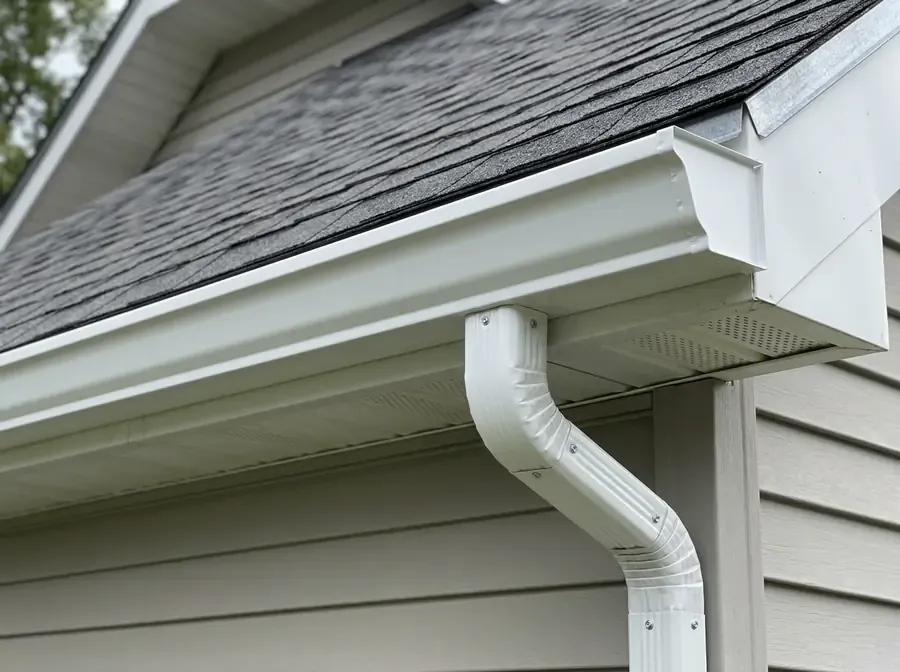
| Behind the gutter | No drip edge or gutter apron | Add drip edge; check fascia |
Why do gutters leak so often around Spring?
Gutter sealant is a flexible compound, and the Spring climate attacks it from two sides. Summer heat makes the metal expand and contract every day, flexing the joints. Constant moisture keeps the joint damp: Bush Intercontinental records rain on about 104 days a year and humidity near 75 percent. Wet debris sitting against a joint holds water there between storms, too. Over a few years the sealant hardens, shrinks and lets go.
Storms add their own leaks. Falling limbs can crack a miter or punch through thin metal, and high winds like those in Hurricane Beryl can twist a run enough to open a corner.
Is it a leak or an overflow?
| What you see | Likely cause |
|---|---|
| Steady drip at a corner, even in light rain | Joint leak |
| Drip from under the gutter mid-run | Hole, rust or split seam |
| Water spilling over the front edge in heavy rain | Clog, low spot or gutter too small |
| Water running down the fascia behind the gutter | Missing drip edge |
| Drip only in heavy storms at an inside corner | Valley water overwhelming the corner |
A hose run slowly along the gutter on a dry day shows which it is.
What does a proper leak repair involve?
- Find the actual source with a water test.
- Clean the joint to bare metal, removing all old sealant, and let it dry.
- Re-rivet any loose corner, cap or outlet.
- Seal with a gutter sealant rated for heat and moisture.
- Replace corners or sections that are split or dented.
- Check the pitch so water does not sit at the joint.
- Test with a hose.
Why fix a leak quickly?
A drip at a corner lands in the same spot in every storm. It stains brick, grows mildew on the fascia and rots the wood. On clay soil it also wets the same patch beside the slab, and Houston-area clay swells and shrinks with moisture.
How much does it cost?
National guides put most gutter repairs in the low hundreds of dollars. Resealing a corner sits at the low end; replacing several corners or sections costs more. If an old sectional system leaks at many seams, compare a replacement quote.
Which sealant is right for gutters?
Gutter sealant should stay flexible in heat, stick to aluminum or steel, and resist water. Ordinary household caulk hardens and cracks within a season. A good repair also depends on preparation: the joint must be dry and cleaned to bare metal, with all old sealant removed. Sealant smeared over dirt or old caulk usually fails by the next summer. For copper, the seam is soldered, not caulked.
When is a leak really a roof problem?
Some drips blamed on gutters come from the roof edge. If water appears behind the gutter, runs down the fascia, or stains the soffit, check for missing drip edge, lifted shingles at the eave, or a gap between roof and gutter. A gutter contractor can add a gutter apron or drip edge; damaged shingles are a roofer's job.