
On this page
- Why do gutters sag?
- Why is sagging so common around Spring?
- How is a sagging gutter repaired?
- What do hidden hangers do differently?
- When is replacement the better answer?
- How can you prevent sagging?
- How do you check pitch yourself?
- What does a sag cost to ignore?
- Is there a quick fix until a contractor arrives?
- Related pages
Why do gutters sag?
| Cause | What you see | Fix |
|---|---|---|
| Spikes pulled loose | Nail heads standing out, run dipping | Replace with screw-in hidden hangers |
| Hangers too far apart | Gentle sag between supports | Add hangers about every two feet |
| Heavy wet debris | Gutter full of soaked needles and leaves | Clean, then re-hang |
| Soft or rotten fascia | Screws spin or pull out | Replace the wood, then re-hang |
| Storm damage | Run bent or pulled away after wind or a falling limb | Straighten or replace the section |
| Ladder damage | Dent and dip where a ladder leaned | Replace the section |
Why is sagging so common around Spring?
Weight and wood. Pine needles soak up water and pack into mats, and a gutter full of wet needles is far heavier than an empty one. Loblolly pine is the most common native tree in the region, so many gutters carry that weight for weeks at a time.
The fascia behind is the other half of the problem. In air that averages close to 75 percent humidity, wood that gets wet from overflow stays wet, and it rots from the back. Once screws stop biting, the gutter drops. Storms then finish it off: Hurricane Beryl and the 2024 derecho tore loose plenty of gutters that had been sagging for months.
How is a sagging gutter repaired?
- Clean the gutter so the weight comes off and the cause is visible.
- Check the fascia with a screwdriver. Soft wood is replaced first; see fascia and soffit repair.
- Remove old spikes and fill the holes.
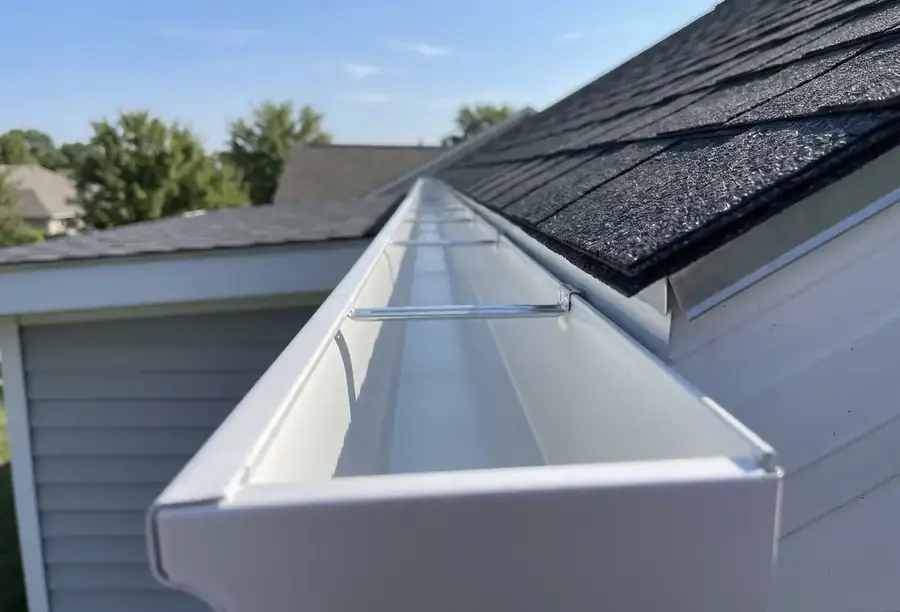
- Fit hidden hangers about every two feet, screwed into solid wood.
- Re-pitch the run for a steady fall to the outlet, about a quarter inch every ten feet.
- Check corners and outlets, which may have opened as the run sagged.
- Test with water.
What do hidden hangers do differently?
| Spike and ferrule | Hidden hanger | |
|---|---|---|
| How it holds | Long nail through the gutter into the fascia | Bracket inside the gutter, screwed into the fascia |
| Grip over time | Loosens as wood swells and shrinks | Screw threads hold |
| Spacing | Often 24 to 36 inches | About every 24 inches |
| Look | Nail heads visible on the face | Hidden |
| Wind resistance | Lower | Higher |
When is replacement the better answer?
If several runs sag, the gutters are old sectional pieces with leaking seams, or the fascia is soft along most of the house, re-hanging may only buy a year or two. A replacement quote is worth comparing.
How can you prevent sagging?
- Clean the gutters before they fill, especially under pines. See how often to clean.
- Never lean a ladder against the gutter.
- Ask for screw-in hidden hangers on any new installation.
- Fix overflow early so the fascia stays dry and sound.
How do you check pitch yourself?
On a dry day, pour a bucket of water into the far end of a run and watch. It should flow steadily to the outlet and drain within a minute or so. If water sits in the middle, the gutter is sagging or pitched wrong. A string line from end to end, or a level on the gutter lip, shows how far it has dropped. A typical fall is about a quarter inch for every ten feet toward the outlet.
What does a sag cost to ignore?
A sagging run holds standing water. That water grows mildew and mosquitoes, keeps the fascia wet so it rots further, adds weight that pulls more hangers loose, and spills over the low point onto the same patch of soil every storm. Each of those makes the eventual repair bigger. Re-hanging a run is a modest job; replacing rotted fascia along a whole side is not.
Is there a quick fix until a contractor arrives?
Clearing the debris takes most of the weight off and often lifts the gutter slightly. Do not screw new hangers into fascia that feels soft, and do not lean a ladder on the sagging section. If the run is close to falling, especially before a storm, tie it off or call for a prompt visit.