
On this page
- What is the quick comparison?
- Why does size matter more around Spring?
- How much water does a roof send to its gutters?
- Which houses need 6-inch?
- When is 5-inch still fine?
- What about downspouts?
- How much more does 6-inch cost?
- How do you decide?
- What does overflow actually cost?
- Can you upgrade without replacing everything?
- What about the look on brick homes?
- Does gutter size change cleaning?
- Next steps
What is the quick comparison?
| 5-inch K-style | 6-inch K-style | |
|---|---|---|
| Capacity | Standard | About 40% more |
| Downspout | Usually 2x3 | Usually 3x4 |
| Pine needles at outlets | Clogs sooner | Passes more debris |
| Look | Suits small and single-storey homes | Suits large and two-storey homes |
| Hangers | Standard | Rated for heavier loads |
| Cost | Lower | Somewhat higher per foot |
Why does size matter more around Spring?
Gutters are sized for the hardest rain they will see, and this area sees hard rain. Bush Intercontinental averages about 52 inches of precipitation a year, with June near 6 inches. Extreme events are part of the record too. Tropical Storm Allison dropped up to 37 inches on parts of Houston in 2001, Harvey brought about 30 inches along Cypress Creek in 2017, and Hurricane Beryl dropped 7.2 inches on the Spring area in a single day in 2024.
Gutters are not meant to carry a hurricane's worth of water without spilling. But everyday thunderstorms here can still dump an inch or more in under an hour, and that is what most gutters must handle well.
How much water does a roof send to its gutters?
Each square foot of roof sheds about 0.62 gallons for every inch of rain.
| Roof area | Gallons in 1 inch of rain |
|---|---|
| 1,500 sq ft | About 930 |
| 2,500 sq ft | About 1,550 |
| 3,500 sq ft | About 2,170 |
Most of that arrives in the heaviest few minutes. Roof pitch matters too: a steep roof sends water faster, and a valley concentrates water from two roof planes onto one corner.
Which houses need 6-inch?
- Two-storey homes, where the upper roof sheds onto lower roofs and into the same gutters.
- Large hip roofs, common on brick homes in Spring-area subdivisions.
- Roofs with valleys that pour onto inside corners.
- Steep roofs on custom homes.
- Metal roofs, which shed water quickly.
- Houses under loblolly pines, where larger outlets clog far less. Loblolly is the most common native tree in the region.
When is 5-inch still fine?
A single-storey house with a modest, low-pitch roof, few valleys and no trees overhead often does well with 5-inch gutters and enough downspouts. If the only overflow is at one corner, adding a downspout there may solve it without upsizing.
What about downspouts?
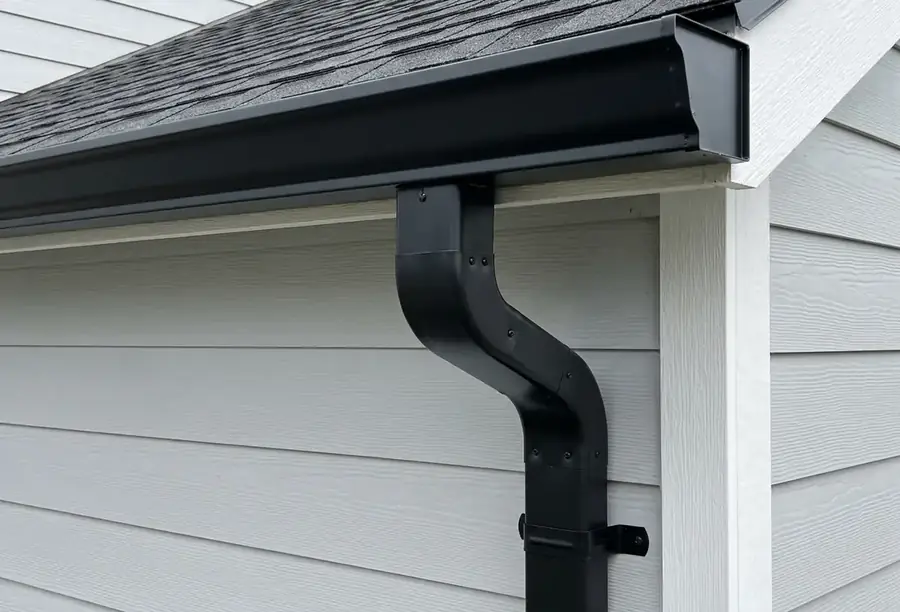
Downspout size matters as much as gutter size. A 3x4 downspout drains much faster than a 2x3 and is far less likely to plug with needles or sweetgum balls at the elbow. More outlets help too: two downspouts on a long run halve the water each must carry. Wherever the water comes down, carry it well away from the slab; see downspout drainage.
How much more does 6-inch cost?
National guides put seamless aluminum at about $9 to $13 a foot installed for 5-inch, with 6-inch costing more per foot plus the larger downspouts. On a typical house, the difference is a modest share of the total, and usually far less than repairing rotten fascia or yard and slab problems caused by repeated overflow.
How do you decide?
| Your house | Likely choice |
|---|---|
| Single storey, small roof, no trees | 5-inch |
| Single storey, big roof or valleys | 6-inch, or 5-inch with extra downspouts |
| Two storey | 6-inch |
| Heavy pine cover | 6-inch with 3x4 downspouts, plus guards |
| Steep or metal roof | 6-inch |
A contractor should measure the roof and explain the size they suggest.
What does overflow actually cost?
Undersized gutters rarely fail in one dramatic event. They overflow a little in every heavy storm, and the damage builds:
| Repeated overflow causes | Result over time |
|---|---|
| Water down the face of the fascia | Rot, peeling paint, loose hangers |
| Water onto the same patch of soil | Washouts and uneven wetting beside the slab |
| Splashback onto brick and siding | Mildew, stains, wet window sills |
| Water onto walkways and doors | Slip hazards, water at thresholds |
On clay that expands when wet and shrinks when dry, uneven wetting near the foundation is the costliest of these. A larger gutter and downspout can cost less than one fascia repair.
Can you upgrade without replacing everything?
Sometimes. Options include:
- Adding a downspout at the point where the gutter overflows.
- Upsizing outlets from 2x3 to 3x4 on the existing gutter, where the gutter is deep enough.
- Replacing only the runs below valleys or the largest roof planes with 6-inch.
If the existing gutters are old, leaking or sagging, replacing the whole system in one size is usually cleaner and avoids mismatched profiles. A contractor can show which runs actually carry the most water.
What about the look on brick homes?
Six-inch gutters have a deeper face. On a two-storey brick house that face reads as part of the trim line, and most owners do not notice the difference. On a low single-storey house with a thin fascia, the larger face can look heavy. Color helps: matching the gutter to the trim or roof edge makes either size recede.
Does gutter size change cleaning?
Slightly. A 6-inch gutter holds more debris before it overflows and its 3x4 outlets clog less, so it tolerates a longer gap between cleanings.