
On this page
- Why do downspouts matter so much around Spring?
- What are the discharge options?
- How are downspouts sized?
- Where should downspouts go on a house?
- What should the installation include?
- Can downspouts be made to look better?
- What about rain chains and barrels?
- How often should downspouts be checked?
- Related pages
Why do downspouts matter so much around Spring?
Because most houses here sit on slab foundations on clay. Houston-area clay absorbs water and expands when wet, then shrinks and cracks as it dries, and that repeated movement can create uneven soil under a home. A downspout that empties right beside the slab soaks the same patch of soil every storm. Texas A&M AgriLife specialists recommend gutters and downspouts so that water does not pool at the foundation.
The other reason is volume. With about 52 inches of rain a year, a single downspout draining a large roof section moves thousands of gallons a year. Where it lands decides whether the yard drains or ponds. The Harris County Flood Control District notes that many homes flood because water cannot reach the street drainage fast enough.
What are the discharge options?
| Option | How it works | Good for | Watch for |
|---|---|---|---|
| Extension | Extra length of downspout or a pipe on the ground | Simple, cheap, movable | Mowers and foot traffic knock them off |
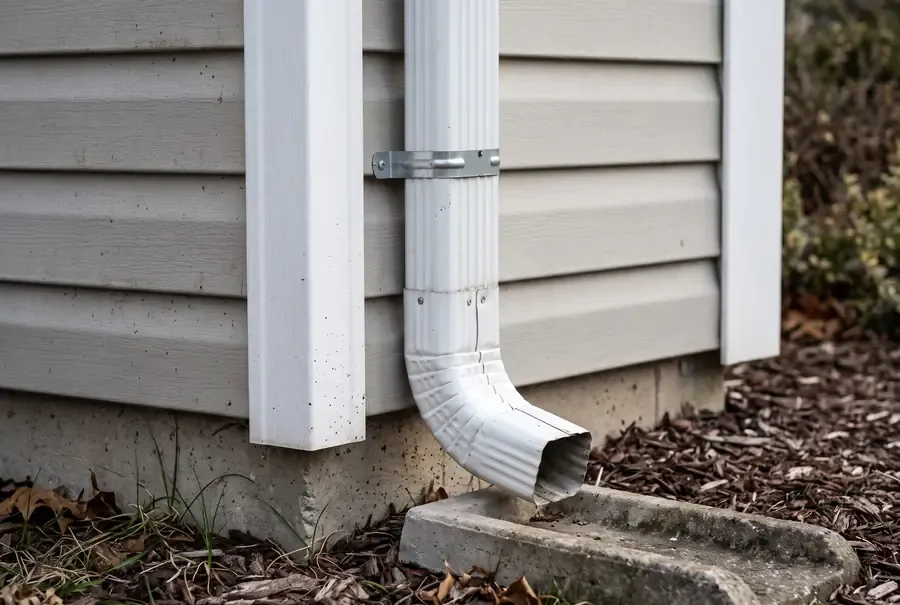
| Splash block | Concrete or plastic tray under the outlet | Spreading flow | Too short on its own for clay soil |
| Flip-up extension | Hinged section that lifts out of the way | Paths and lawns | Must be lowered before storms |
| Buried line | Solid pipe underground to a pop-up or curb outlet | Long distances, tidy yards | Needs a clear outlet and occasional flushing |
| Pop-up emitter | Cap at the end of a buried line that opens under pressure | Lawns | Can clog with silt and grass |
How are downspouts sized?
| Downspout | Pairs with | Notes |
|---|---|---|
| 2x3 inch | 5-inch gutters, small roofs | Clogs sooner with pine needles |
| 3x4 inch | 6-inch gutters, large roofs | Drains much faster; passes debris |
| Round 3 or 4 inch | Half-round gutters | Traditional look |
On a big roof, two well-placed 3x4 downspouts often do more than three 2x3s. Valleys that pour onto one corner usually need their own outlet.
Where should downspouts go on a house?
| Location | Reason |
|---|---|
| At each end of long runs | Shortens the flow and halves the load |
| Below valleys | Valleys pour concentrated water onto one spot |
| Toward the street or a swale | Lets water leave the lot |
| Away from patios and doors | Keeps water and debris off living areas |
| Away from neighbors' fences | Avoids sending your water onto their lot |
What should the installation include?
- Outlets placed where the roof sends the most water, including valleys.
- Downspouts strapped to the wall at top, middle and bottom so storm winds cannot rip them loose.
- Elbows wide enough to pass needles, or with a clean-out.
- Discharge several feet from the slab onto ground that slopes away.
- Buried lines with solid pipe, a clean outlet and a way to flush them.
Can downspouts be made to look better?
Downspouts are often the most visible part of a gutter system, especially on brick fronts. A few options help:
- Color-matched coil in brick, stone or trim colors so the downspout blends into the wall.
- Placement at inside corners where they disappear into the shadow line.
- Round downspouts on traditional houses with half-round gutters.
- Buried lines so there is no extension across the lawn.
What about rain chains and barrels?
Rain chains are decorative and slow water down, but they splash and spill in heavy rain, so they suit porches and low-flow corners rather than main roof outlets. Rain barrels hold the first part of a storm and can water beds, but in a region with about 52 inches of rain a year they fill quickly, and the overflow still needs a route away from the slab. Keep barrels covered to keep mosquitoes out.
How often should downspouts be checked?
Once or twice a year, and after storms. Pour water in at the top and watch the outlet. Look for crushed sections at the bottom where mowers and cars hit them, loose straps, and extensions knocked out of place.