
On this page
- What are the common downspout problems?
- Why does discharge matter so much on clay soil?
- Extension, splash block or buried line?
- How do you test a buried line?
- What does a downspout repair include?
- How much does it cost?
- Why do downspouts get crushed?
- What are signs a buried line has failed?
- Should downspouts connect to the street?
- Related pages
What are the common downspout problems?
| Problem | Signs | Fix |
|---|---|---|
| Clogged elbow or outlet | Gutter overflows near the downspout; downspout dry in a storm | Clear the clog; consider 3x4 downspouts |
| Crushed or dented | Visible flattening from a limb, mower or car | Replace the section |
| Loose or missing straps | Downspout swinging or pulled off the wall | Re-strap at top, middle and bottom |
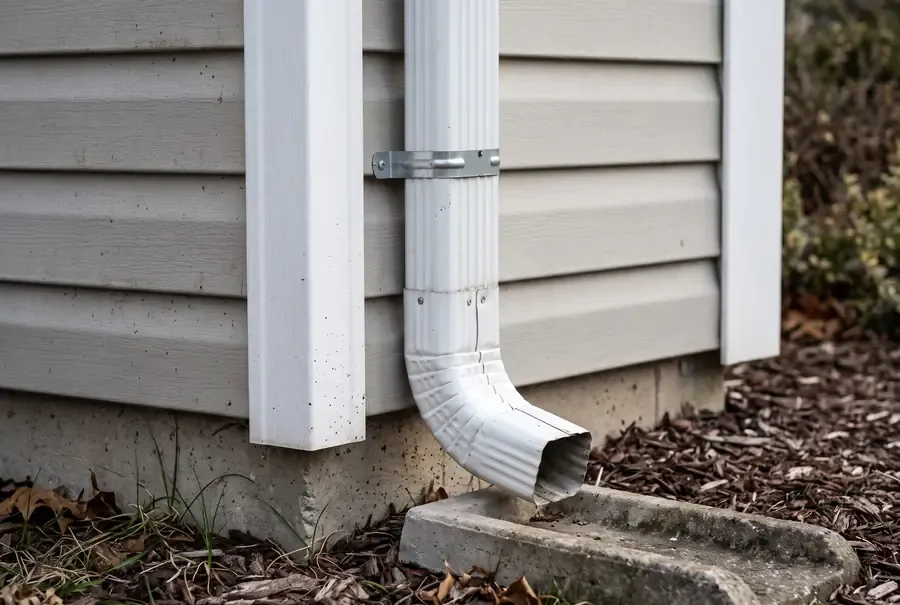
| Short or missing extension | Wet soil or puddle at the foundation | Add an extension or buried line |
| Blocked buried line | Water bubbling up near the house | Flush or replace the line; fix the outlet |
| Wrong location | Water onto a walkway, driveway or patio | Reroute the downspout |
Why does discharge matter so much on clay soil?
Houston-area clay absorbs water and expands, then shrinks and cracks as it dries, and that cycle can leave uneven soil under a house. A downspout that empties beside the slab soaks the same patch every storm. Texas A&M AgriLife specialists recommend gutters and downspouts so water does not pool around the foundation, and inspectors who work on expansive soils say downspouts should be long enough to carry water to a swale or drain.
The volume is large. Bush Intercontinental averages about 52 inches of precipitation a year. A downspout serving 800 square feet of roof sends roughly 26,000 gallons a year to wherever it ends.
Extension, splash block or buried line?
| Option | Cost | Distance | Upkeep |
|---|---|---|---|
| Splash block | Low | Short, often too short on clay | Keep it under the outlet |
| Downspout extension | Low | Several feet | Put back after mowing |
| Flip-up extension | Low to moderate | Several feet | Lower before storms |
| Buried solid line | Moderate to high | As far as needed | Flush now and then; keep outlet clear |
How do you test a buried line?
Run a hose into the top of the downspout and watch the outlet. If water backs up at the downspout or bubbles out of the ground near the house, the line is blocked or broken. Many can be cleared with a drain snake or water jet; crushed or root-damaged lines are replaced.
What does a downspout repair include?
- Clear any clog at the outlet, elbows and bottom.
- Replace crushed sections and elbows.
- Re-strap the downspout to the wall.
- Extend the discharge several feet onto ground that slopes away.
- Test with a hose to confirm the water goes where it should.
How much does it cost?
Most downspout repairs are modest jobs. National guides put typical gutter repairs in the low hundreds of dollars. Buried lines and regrading cost more. Get the price in writing.
Why do downspouts get crushed?
The bottom few feet of a downspout take the most abuse. Mowers, string trimmers, bins, bikes and car bumpers hit them, and children and pets knock extensions out of place. Once a downspout is crushed, it narrows the opening and catches needles and leaves, which turns a small dent into a regular clog. Moving the downspout to a protected corner, adding a flip-up extension, or running the discharge into a buried line keeps it out of harm's way.
What are signs a buried line has failed?
| Sign | Likely cause |
|---|---|
| Water overflowing at the downspout top in heavy rain | Line blocked downstream |
| Soggy ground or sinkhole along the line | Joint separated or pipe cracked |
| No water at the pop-up or curb outlet | Blocked emitter or crushed pipe |
| Roots at the outlet | Roots have entered the line |
Many lines are corrugated pipe, which holds debris in its ridges. Replacing failed sections with smooth solid pipe and a clean-out makes future clogs easier to clear.
Should downspouts connect to the street?
Where the lot slopes toward the street and local rules allow, carrying roof water to a curb outlet keeps it off the yard. The Harris County Flood Control District notes that streets are part of the drainage system. Ask the contractor whether a curb outlet is permitted where you live; HOAs and cities sometimes set rules.